Thomae's function
Thomae’s function (a.k.a. Riemann function) is defined on the interval (0, 1) as follows
\[f(x) = \left\{ \begin{array}{l l} 1/q & \quad \text{if $x = p/q$ is rational and $gcd(p, q) = 1$}\\ 0 & \quad \text{if $x$ is irrational}\\ \end{array} \right.\]Here is the graph of this function with some points highlighted as plus symbols for better view.
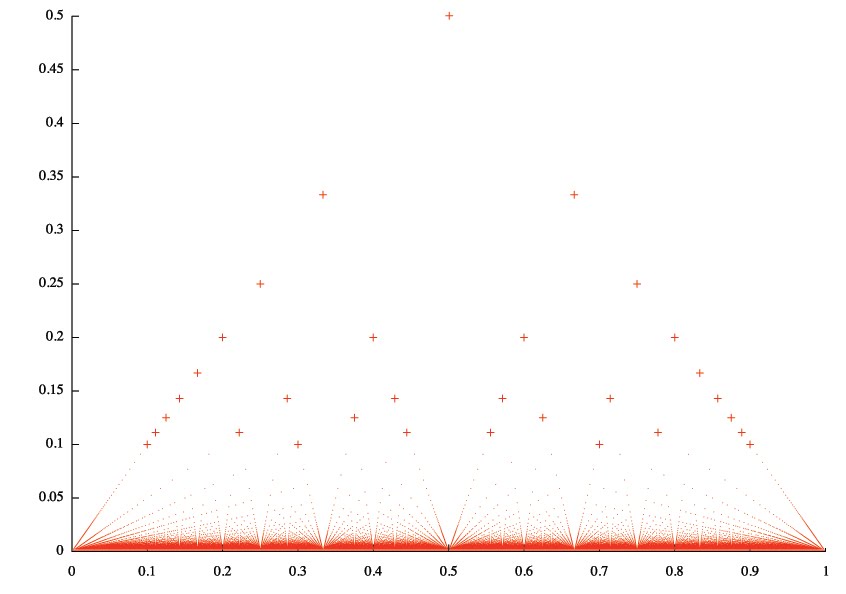
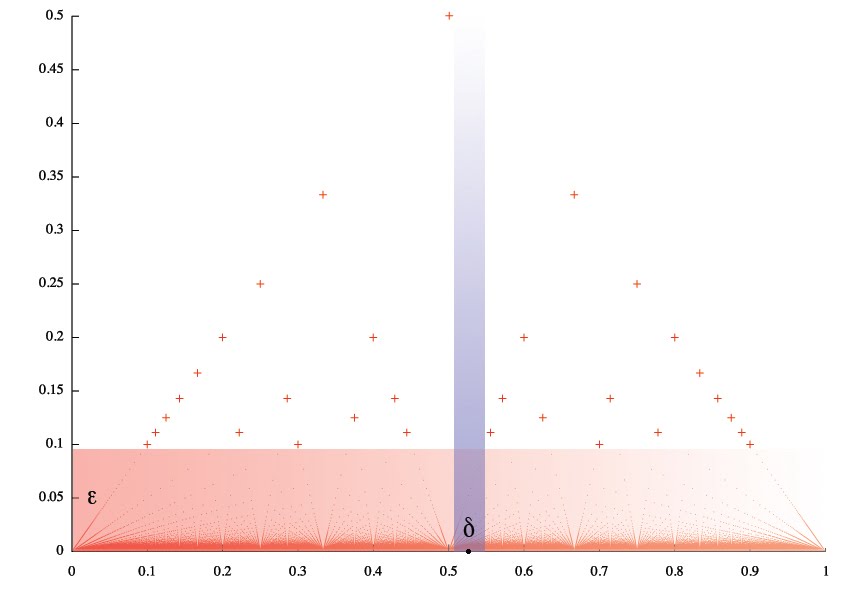
This function has interesting property: it’s continuous at all irrational points. It’s easy to see this if you notice that for any positive ε there is a finite number of dots above the line y = ε. That means for any irrational number x0 you can always construct a δ-neighbourhood that doesn’t contain any dot from the area above the line y = ε.
To generate the data file with point coordinates I wrote Common Lisp program:
(defun rational-numbers (max-denominator)
  (let ((result (list)))
    (loop for q from 2 to max-denominator do
      (loop for p from 1 to (1- q) do
        (pushnew (/ p q) result)))
    result))

(defun thomae-rational-points (abscissae)
  (mapcar (lambda (x) (list x (/ 1 (denominator x)))) abscissae))

(defun thomae (max-denominator)
  (let ((points (thomae-rational-points (rational-numbers max-denominator))))
    (with-open-file (stream "thomae.dat" :direction :output)
      (loop for point in points do
        (format stream "~4$ ~4$~%" (first point) (second point))))))

(thomae 500)
To create the images I used gnuplot commands:
plot "thomae.dat" using 1:2 with dots
plot "thomae.dat" using 1:2 with points
and Photoshop.